
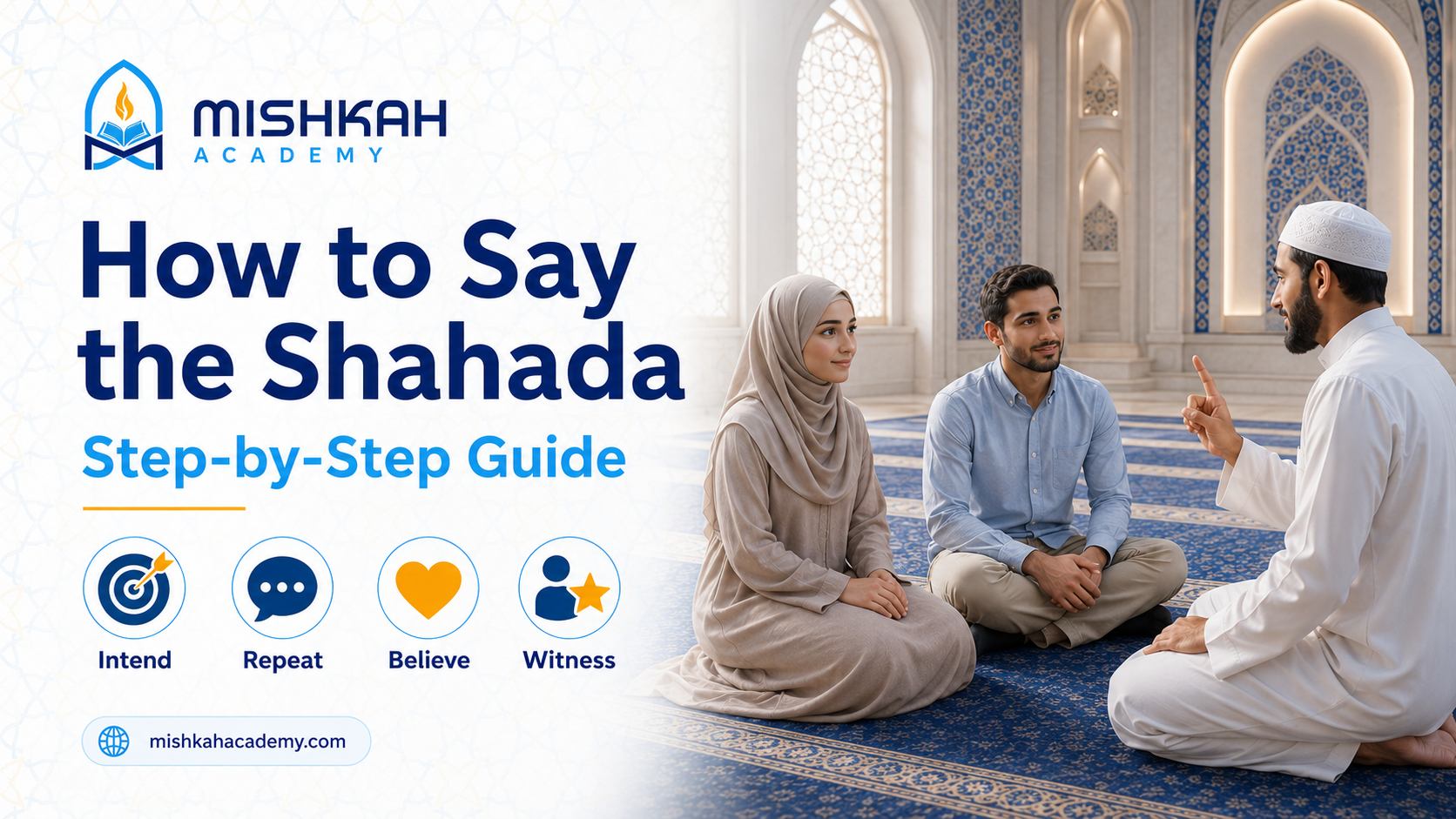
The Shahada is the most recited sentence in Islamic history. Spoken at birth into a Muslim child’s ear, declared at conversion, embedded in every Adhan (call to prayer), woven into every unit of Salah — the Shahada in Arabic has been on the lips of Muslims for over 1,400 years.
For new Muslims and seekers, learning to say the Shahada correctly is one of the most meaningful early milestones. But Arabic pronunciation is unfamiliar to most English speakers, and the sounds of the Shahada include letters that have no equivalent in English.
Saying The Shahada In Arabic & English
Table of Contents
ToggleThe Shahada is the Islamic declaration of faith and the first of Islam’s Five Pillars. A person enters Islam by sincerely believing in its meaning and declaring it.
| The Shahada in Arabic is: أَشْهَدُ أَنْ لَا إِلٰهَ إِلَّا ٱللَّٰهُ وَأَشْهَدُ أَنَّ مُحَمَّدًا رَسُولُ ٱللَّٰه — transliterated as: “Ash-hadu an lā ilāha illā Allāh, wa ash-hadu anna Muḥammadan rasūlullāh.” Pronounce it slowly, word by word, with the emphasis on the long vowels (ā). Every Arabic letter has a distinct sound — this guide breaks each one down. |
| 🔗 Related Guide
If you want to understand how to say the Shahada formally as a declaration of faith? Read our complete guide to making the Shahada as a new Muslim. |
| 🎧 Fastest way to say the shahada
The absolute fastest way to say the Shahada in10 minutes with a qualified Sheikh. Mishkah Academy’s scholars guide new Muslims through the Shahada word by word in your first session. |
How To Say The Shahada: Full Text
The complete Shahada in Arabic script, with full diacritical marks (tashkeel):
أَشْهَدُ أَنْ لَا إِلٰهَ إِلَّا ٱللَّٰهُ وَأَشْهَدُ أَنَّ مُحَمَّدًا رَسُولُ ٱللَّٰه
“I bear witness that there is no god but Allah, and I bear witness that Muhammad is the Messenger of Allah.”
| Ash-hadu an lā ilāha illā Allāh,
wa ash-hadu anna Muḥammadan rasūlullāh. |
The most effective way to learn the Shahada in Arabic is word by word. Do not try to memorize the full sentence at once — master each segment before moving on.
| Arabic | Transliteration | Sounds Like (English) | Pronunciation Note |
| أَشْهَدُ | Ash-hadu | ash-HA-doo | The ‘sh’ is like in “shop”. Short final ‘u’. Stress the middle syllable: ash-HA-du. |
| أَنْ | an | un (as in “under”) | Very short connecting particle. Do not drag it out. |
| لَا | lā | laa (long “a”) | The long ā must be held — approximately twice the length of a short vowel. “Laa” not “la”. |
| إِلٰهَ | ilāha | i-LAA-ha | Three syllables. The long ā in the middle is critical. “i-LAA-ha”, not “illa-ha”. |
| إِلَّا | illā | il-LAA | The “ll” is doubled (Shadda) — hold it slightly longer. Then a long ā. |
| ٱللَّٰهُ | Allāh | Al-LAAH | The “l” after “Al-” is heavy (tafkheem) when preceded by a fatha. The most sacred name — pronounce with care. |
| وَ | wa | wa (as in “want”) | Simple connector meaning “and”. Short vowel, no elongation. |
| أَشْهَدُ | ash-hadu | ash-HA-doo | Repeated from Part 1 — same pronunciation rules apply. |
| أَنَّ | anna | AN-na | The “n” carries a Shadda (doubled) — hold it slightly. Two syllables: AN-na. |
| مُحَمَّدًا | Muḥammadan | mu-HAM-ma-dan | The “H” (ح) is a deep, breathy sound from the throat — not the English “h”. The “mm” is doubled. Four syllables. |
| رَسُولُ | rasūlu | ra-SOO-loo | The long ū in the middle — hold it. Three syllables: ra-SOO-lu. |
| ٱللَّٰه | Allāh | Al-LAAH | Same as above. Here at end of sentence — slightly elongated by natural pause. |
| 🎧 Tip: Use Your Ears, Not Just Your Eyes
Practice method: Record yourself saying each word slowly on your phone. Then listen back and compare to a native Arabic recitation (search “shahada pronunciation slow” on YouTube). Your ear will catch what your eye misses. |
“Lā ilāha illā Allāh” — the Full Shahada
Many Muslims — and some non-Muslims — have heard “Lā ilāha illā Allāh” spoken or written alone. This is the first half of the Shahada, and it is one of the most frequently recited phrases in Islam.
| Phrase | Status | When Used |
| Lā ilāha illā Allāh (first half alone) | Complete by itself as dhikr (remembrance of Allah) | Daily dhikr, tahleel, after prayer, on prayer beads (tasbeeh) |
| Full Shahada (both parts with “Ash-hadu”) | Complete formal declaration of faith | Conversion, Adhan, Iqamah, Tashahhud in prayer |
| Kalima Tayyiba (without “Ash-hadu”) | Valid as general dhikr — common in South Asian tradition | General remembrance; not used for formal conversion ceremony |
For the formal act of conversion to Islam, the full Shahada — both parts, with “Ash-hadu” — is required. The Prophet ﷺ used to ask those entering Islam to declare the complete formula (Sahih al-Bukhari, 8).
| 🕌 Say the Shahada With a Sheikh — Free
A Mishkah Academy scholar will guide you through every word in a private session — saying the shahada in real time. Walk away saying it in no time. |
Common Pronunciation Mistakes Saying TheShahada
These are the most frequent errors among new Muslims learning the Shahada in Arabic, particularly for English, Spanish, French, and Urdu speakers:
| Mistake | What People Say | What It Should Be | Why It Matters |
| Shortening long vowels | “la ilaha” (short a) | “lā ilāha” (long aa) | Long vowels carry grammatical meaning. Shortening them can technically change the meaning of a word. |
| Skipping the Shadda | “anna” said as “ana” | “anna” — the n is doubled | Shadda doubles a consonant. “Anna” (that) and “ana” (I) are different words — Shadda matters. |
| Light “l” in Allah | Al-lah (light English l) | Al-LAAH (dark/heavy l) | The heavy lam is specific to Allah’s name. A light “l” sounds incorrect to Arabic speakers. |
| Rushing the sentence | Saying it as one fast blur | Slow, deliberate, word by word | Speed is the enemy of correct Arabic. The Prophet ﷺ recited slowly (tarteel). Meaning lands better when spoken deliberately. |
| “Muhammedan” mispronounced | moo-HAM-eh-dan | mu-HAM-ma-dan (4 syllables) | The ح (deep h) is replaced with a regular English “h”, and the syllable count is wrong. |
| Merging “illā Allāh” | “illallah” (fully merged) | “illā — Allāh” (natural break) | The two lams merge phonetically (idghaam), but a natural breath between them is the standard recitation. |
| ⚠️ Reassurance for New Muslims
An imperfect pronunciation does NOT invalidate your Shahada or your prayer, as long as you are genuinely trying. Scholars unanimously agree that Allah accepts the effort of a sincere learner. Correct your pronunciation gradually — it is a process, not a gate. |
How to Memorize the Shahada in Arabic: Step-by-Step Method
Memorization is easier than it looks. The Shahada has a natural rhythm that makes it memorable. Here is a proven method used in Islamic schools worldwide:
| Step | What to Do | Time Needed |
| 1 | Learn Part 1 alone: “Ash-hadu an lā ilāha illā Allāh” — repeat 10 times slowly | 10 minutes |
| 2 | Learn Part 2 alone: “wa ash-hadu anna Muḥammadan rasūlullāh” — repeat 10 times | 10 minutes |
| 3 | Combine both parts — say the full Shahada slowly 5 times, pausing at “wa” | 5 minutes |
| 4 | Check your long vowels — say it again, consciously holding every ā and ū for two beats | 5 minutes |
| 5 | Record and compare — listen back, compare to a native Arabic speaker’s recitation | 10 minutes |
| 6 | Say it in context — recite as morning dhikr for one week. Context cements memory. | Ongoing |
| “Most people can memorize the Shahada correctly in a single focused 30-minute session. The key is not speed — it is accuracy on the long vowels and doubled letters (Shadda). Once you have those right, the rest follows naturally.”
— Mishkah Academy Teachers |
FAQs how to say the Shahada
Q: Can I say the Shahada in Arabic & English?
A: The Arabic form is the scholarly standard used worldwide. Scholars allow a new convert to say it in English only if they have no knowledge of Arabic at all, with the firm intention to learn the Arabic. The Arabic form is the goal — and with this guide, it is achievable quickly.
Q: Saying the Shahada during my conversion?
A: Your conversion is valid. Scholars are unanimous that a sincere declaration with imperfect pronunciation — when the person is genuinely trying — is accepted. Work on improving your pronunciation after conversion.
Q: How long does it take to say the Shahada?
A: Most people can pronounce the Shahada correctly after a single focused 30-minute session. Full fluency and natural flow come with repetition over a few weeks of daily dhikr. A teacher can correct your pronunciation in the first lesson.
Start Learning with Mishkah Academy
Continue your journey with these essential guides from Mishkah Academy:
→ How to Make Shahada: Complete Step-by-Step Guide (2026)
→ How to Convert to Islam: Complete Guide
→ How to Become a Muslim: Step-by-Step Guide
Conclusion
Learning to say the Shahada correctly is a journey, not a test. Every new Muslim who has ever said it has done so imperfectly at first. The Prophet ﷺ was patient with those who came to him mispronouncing, misremembering, struggling. He never turned anyone away because their Arabic was not perfect.
What matters is sincerity. What matters is intention. What matters is that you keep returning to these words — in prayer, in dhikr, in moments of difficulty and moments of gratitude — until they become as natural to your tongue as your own name.
The Shahada is not just something you learn. It is something you live.
| 🕌 Learn to Say the Shahada — with a Teacher
Mishkah Academy’s New Shahada Classes pair you 1-on-1 with a certified teacher from your very first session. |
📚 Sources & Further Reading:
|