
Best Online Quran Classes for Kids around the World
Table of Contents
ToggleAn honest, complete guide — what to look for, what to avoid, how to choose the right teacher, and what your child should be achieving at each stage of their Quran journey.
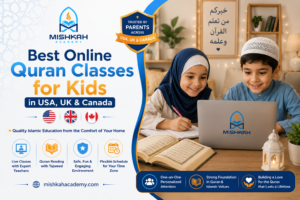
Finding the right Quran teacher for your child is one of the most important decisions you will make as a Muslim parent. Unlike choosing a maths tutor or a sports coach, a Quran teacher carries something far heavier — the responsibility of instilling love for the Book of Allah in a young heart, and building a foundation of correct recitation that your child will carry for the rest of their life.
The good news: online Quran education in 2026 has never been better — more accessible, more structured, and taught by more qualified teachers than at any point in history. The challenge: not every platform is equal, and a bad experience early can put a child off Quran learning for years.
This guide gives you everything you need to make the right choice — backed by Islamic guidance and practical experience teaching thousands of Muslim children in the USA, UK, Canada, and Australia.
خَيْرُكُمْ مَنْ تَعَلَّمَ الْقُرْآنَ وَعَلَّمَهُKhayrukum man ta’allamal-Qur’aana wa ‘allamah
“The best of you are those who learn the Quran and teach it.” — Prophet Muhammad ﷺ (Sahih Al-Bukhari)
Ready to Get Started?
Every day you delay is a day your child’s Quran journey could have begun. Mishkah Academy’s certified teachers are ready for students of all ages — from 4-year-olds beginning their first Arabic letters to teenagers pursuing Hifz.
Why Online? The Case for Learning Quran at Home in 2026
For Muslim families living in the West, finding a qualified Quran teacher nearby has always been difficult. Most cities have a mosque, but the quality and consistency of Quran teaching varies enormously. Many parents drive children across town for mediocre lessons — or worse, leave their Quran education to chance.
Online learning solves the access problem without sacrificing quality — when done right. Here is what makes it genuinely superior for most Western Muslim families:
| Challenge for Western Muslim families | How online learning solves it |
|---|---|
| No qualified teacher nearby | Access certified teachers regardless of your location — teachers who have studied at Al-Azhar, Madinah University, or hold a chain of Ijazah |
| Inconsistent local mosque schedule | Classes booked around your family’s timetable — evenings, weekends, or mornings before school |
| Child shy or uncomfortable in group settings | One-on-one lessons build confidence; your child’s pace, not a class’s pace |
| Safety concerns | Parents can sit in, observe, or review session recordings at any time |
| No standardized curriculum | Structured progression: Noorani Qaida → Tajweed → Hifz — with measurable milestones |
| Expensive private tutors | Online platforms offer professional-quality teaching at significantly lower cost than in-person private tutors |
The 8 Non-Negotiable Criteria for Choosing an Online Quran Platform
Most platforms claim to offer “certified teachers” and “structured curriculum.” Here is how to tell the real ones from the marketing:
1. Teacher qualification — not just “certified”
2. Experience teaching children specifically
3. Free trial — before you commit
4. Structured, progressive curriculum
5. Parent visibility and reporting
6. Same-gender teacher option
7. Continuity of teacher
8. Flexible scheduling & makeup policy
Age-by-Age Guide: What Your Child Should Learn and When
One of the biggest mistakes parents make is expecting too much too soon — or not starting early enough. Here is a realistic, age-appropriate roadmap:
- Ages 3–5 Pre-Qaida: Letter Recognition and Love of Quran
- Ages 5–7 Noorani Qaida: Building the Foundation
- Ages 7–10 Quran Reading + Basic Tajweed
- Ages 10–14 Formal Tajweed + Hifz Programme
- Ages 14+ / Adults Advanced Tajweed + Arabic Language
What a Quality 30-Minute Online Quran Class Actually Looks Like
If you sit in on your child’s class and see these things, you’re in good hands:
- Warm-up review (5 min) — The teacher revises the last session’s material before introducing anything new. No review = no retention.
- New material introduction (10 min) — One focused concept introduced clearly, with the teacher demonstrating pronunciation and the child repeating back.
- Practice with immediate correction (10 min) — The child reads aloud; the teacher corrects gently in real time. Correction should be specific (“your Daad needs more pressure from the side of the tongue”) not vague (“try again”).
- Revision assignment (3 min) — Clear homework: which exercises to practice, how many times, before the next session.
- Encouragement and close (2 min) — The teacher affirms what the child did well. Children learn faster from encouragement than correction.
What “Certified” Really Means — and What to Ask
The word “certified” is used loosely in the online Quran industry. Here is the hierarchy of qualifications you should know:
| Qualification | What it means | Level |
|---|---|---|
| Ijazah in Hafs ‘an ‘Asim | A documented, unbroken chain of transmission in the most common Quran reading — traceable back through generations to the Prophet ﷺ. The gold standard. | Highest |
| Ijazah in multiple Qira’at | Authorization in more than one recitation style. Rare and impressive but not required for children’s Quran learning. | Highest |
| Al-Azhar or Madinah University graduate | Formal university-level Islamic education, typically including Quran sciences and Tajweed. Strong qualification. | High |
| Tajweed certificate from an accredited institute | A shorter, focused Tajweed qualification — valid if from a known institute; less valuable if from an unverified source. | Medium |
| General “certified teacher” or “certified Quran teacher” | Could mean almost anything. Ask for specifics — what institution, what qualification name, how long the programme was. | Variable |
Why Mishkah Academy for Your Child’s Quran Education
Mishkah Academy was built specifically for English-speaking Muslim families in the USA, UK, Canada, and Australia — families navigating the same challenge: wanting authentic, qualified Islamic education for their children without compromising on quality or convenience.
What sets Mishkah apart for children’s Quran learning:
- Native Arabic-speaking teachers with Ijazah — not generic certificates, but documented authorization in Quranic recitation.
- Structured progression — from Noorani Qaida through full Tajweed to Hifz, with clear milestones parents can track.
- Age-appropriate teaching methods — teachers trained specifically in children’s education, not just Quran recitation.
- One-on-one classes — your child gets 100% of the teacher’s attention for every minute of the lesson.
- Flexible scheduling across all time zones in the USA, UK, Canada, and Australia — including evenings and weekends.
- Same-gender teacher option — female teachers available for girls and teenage students.
- Free trial lesson — meet your teacher and experience the curriculum before any commitment.
Book Your Child’s Free Trial Lesson at Mishkah Academy
One classes is all it takes to see the difference a qualified, dedicated teacher makes. No commitment required — just a free, genuine introduction to how Mishkah teaches.
Common Questions from Parents
- My child has been “learning Quran” at a local mosque for two years but has made almost no progress. What went wrong?
This is more common than most parents realize. Group classes in mosques often have 10–20 children per teacher, making individual correction impossible. The child learns to blend in rather than recite correctly. Switching to a one-on-one online class typically produces more progress in 3 months than years in a group setting — especially if the new teacher first identifies and corrects the habits formed in the group environment.
- How many sessions per week does my child actually need?
For children under 10: 3–4 sessions of 25–30 minutes per week is the sweet spot. Fewer than 3 makes it hard to build momentum; more than 5 risks burnout. For ages 10 and above: 4–5 sessions of 30–45 minutes. For active Hifz: 5–6 sessions daily is standard, though this depends heavily on the child’s readiness and family schedule.
- My daughter is 12 and very self-conscious. She refuses to recite out loud for anyone. Can online learning help?
One-on-one online learning is often the solution for exactly this situation. There is no peer audience, no comparison to siblings, and a skilled teacher can build a private relationship with the student that creates safety to make mistakes. Many self-conscious children who refused group learning thrive in the one-on-one format within weeks.
- My child is 4 years old. Is that too young to start?
For structured Noorani Qaida reading: usually yes — most children are not cognitively ready before 4.5–5 years. But for informal Quran exposure — listening to beautiful recitation, learning short duas, recognizing Arabic letters through play — there is no minimum age. Beginning this informal exposure at 2–3 years builds a love for the Quran that structured learning later builds upon.
- What is the realistic cost of quality online Quran classes for children?
Quality one-on-one online classes from certified teachers typically range from $30–$80 per hour depending on the platform, teacher qualification, and lesson frequency. Avoid platforms that are dramatically cheaper — this usually means unqualified teachers or very high student-to-teacher ratios. The cost of fixing deeply ingrained recitation errors later always exceeds the cost of quality teaching from the start.
- Can a non-Arabic-speaking child learn Quran recitation without also learning Arabic?
Yes — Quran recitation and Arabic language are separate skills. Your child can learn to recite the Quran beautifully and correctly without understanding the meaning. However, adding Arabic language study — even at a basic level — transforms recitation from phonetic exercise to meaningful worship. Many families start with Quran recitation and add Arabic language study once the child is reading confidently. Mishkah Academy offers both tracks.