
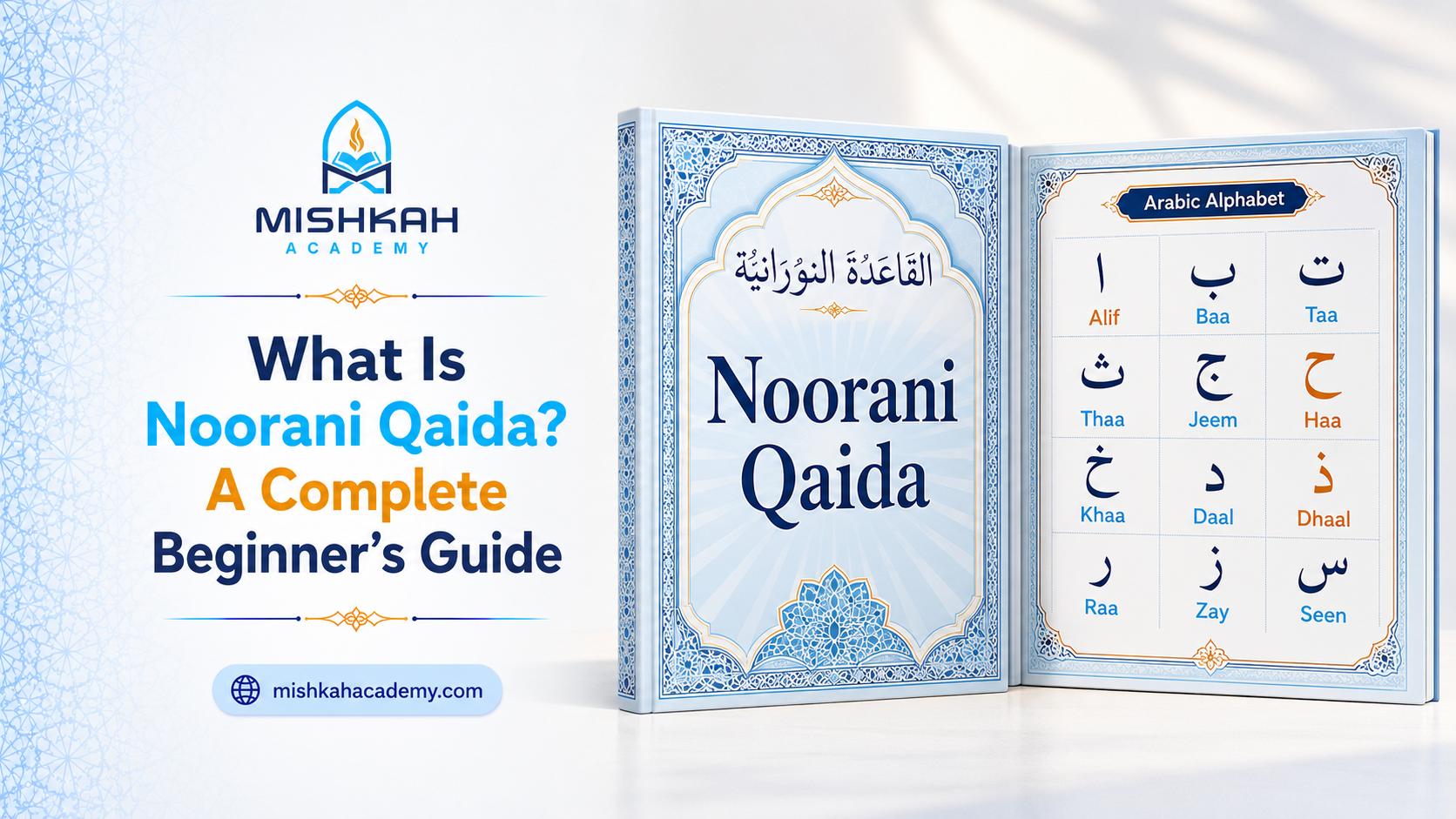
If you’re just beginning to learn how to read the Quran — or if you’re a parent wondering where to start your child — you’ve almost certainly come across the term Noorani Qaida. It comes up in every online Quran class, every Islamic school curriculum, and every conversation with a knowledgeable teacher. But what exactly is it? Why do so many teachers swear by it? And how should you actually use it?
This guide answers all of that — and gives you a clear, practical roadmap for using the Noorani Qaida to build a solid Quranic reading foundation.
What Is the Noorani Qaida?
Table of Contents
ToggleThe Noorani Qaida (also spelled Noorani Qaidah or Qa’ida Nooraniyyah) is a foundational Arabic primer specifically designed to teach beginners how to read the Quran correctly. It is not a Tajweed book in the academic sense — it is a practical entry point that introduces the Arabic alphabet, letter forms, vowel marks, and basic Tajweed rules through progressive, carefully sequenced exercises.
The word qaida (قَاعِدَة) in Arabic means “rule” or “foundation” — and that is precisely what this book provides: the rules and building blocks that allow a complete beginner to go from not knowing a single Arabic letter to reading the Quran with proper pronunciation.
قَاعِدَةٌ نُورَانِيَّةThe word Noorani (نُورَانِيَّة) means “luminous” or “full of light” — named after its author, Sheikh Noor Mohammad Ludhianvi, a Pakistani Islamic scholar who compiled the book in the early 20th century. His goal was to create a simple, systematic guide that any beginner could follow — with or without a teacher.
Who Is the Noorani Qaida For?
| Learner Type | Is Noorani Qaida right for them? | Expected duration |
|---|---|---|
| Children aged 4–7 (pre-reading) | Yes — with a patient teacher, ideally 1-on-1 | 6–12 months depending on pace |
| Children aged 7–14 | Yes — can progress faster with consistent practice | 3–6 months |
| Adult beginners / reverts | Absolutely — adults often progress faster than children | 2–4 months with daily practice |
| Muslims who can read but recite incorrectly | Yes — returning to the Qaida fixes deep-rooted mistakes | 1–2 months (review) |
| Already reading Quran fluently | Not needed — proceed directly to Tajweed rules | — |
The 17 Chapters of the Noorani Qaida — What You Learn at Each Stage
The Noorani Qaida is divided into 17 progressive chapters (lessons). Each chapter builds directly on the previous one. Here is what you master at each stage:
1- The Arabic Alphabet — Individual Letters
أ ب ت ث ج ح خ د ذ ر ز س ش ص ض ط ظ ع غ ف ق ك ل م ن و ه ي
The foundation. You learn the 29 Arabic letters in their independent (isolated) form, their names, and their basic sounds. This is where most mistakes begin if rushed — every letter must be correctly identified and pronounced before moving forward.
2- Letters in Their Different Forms (Beginning, Middle, End)
بَـ ـبَـ ـبَ
Arabic letters change shape depending on whether they appear at the beginning, middle, or end of a word. This chapter introduces all four positions (isolated, initial, medial, final) for each letter — a concept that does not exist in English and requires dedicated practice.
3- Short Vowels (Harakat) — Fatha, Kasra, Damma
بَ بِ بُ
Introduces the three short vowel marks — fatha (ـَ), kasra (ـِ), and damma (ـُ) — which give letters their “a,” “i,” and “u” sounds respectively. You practice reading simple letter-vowel combinations before moving to words.
4- Tanween — Double Vowels at Word Endings
بًا بٍ بٌ
Tanween adds an “n” sound to vowels at the end of words (an, in, un). Common in Quranic Arabic. This chapter also introduces the rules governing tanween with specific letters.
5- Long Vowels (Madd Letters) — Alif, Waw, Ya
بَا بُو بِي
Introduces the three long vowel sounds using the letters Alif, Waw, and Ya — pronounced for two counts (two beats) in length. This is the entry point into the concept of Madd (elongation), which is central to Tajweed.
6- Sukoon — The Vowel-less Letter
بْ
Sukoon (a small circle above a letter) indicates that the letter has no vowel. You learn how to stop cleanly on a letter without adding any extra sound — a critical skill for correct Quranic recitation.
7- Shaddah — The Doubled Letter
بَّ
Shaddah (ـّ) indicates that a letter is doubled — pronounced once held and once released. It significantly changes the meaning of a word. This chapter gives extensive practice recognizing and pronouncing shaddah correctly.
8–12 Qalqalah, Maddaat, Lam Rules, and Special Letters
قَطْبُ جَدٍّ — اللَّهُ — رَرَّ
These chapters introduce more advanced rules: Qalqalah (the “bouncing” sound of certain letters), extended Madd types, the rules governing Lam (ل) in Allah’s name, and letters with distinctive pronunciation rules such as Ra (ر), Lam (ل), and the Moon vs. Sun letters.
13–17 Noon Sakinah, Meem Sakinah, and Waqf Rules
مِنْ — عَمَّ — وَقْفٌ
The final chapters cover the rules of Noon Sakinah and Tanween (Idgham, Ikhfa, Iqlab, Izhar), Meem Sakinah rules, and the rules of stopping (Waqf) — where and how to pause during Quran recitation. Completing these chapters marks the end of the Qaida and the beginning of Quran reading proper.
How Noorani Qaida Differs From Other Methods
| Method | Approach | Best for | Limitation |
|---|---|---|---|
| Noorani Qaida | Systematic, progressive — letters → vowels → rules | Complete beginners, children, adults | Requires consistent practice; best with a teacher |
| Baghdad Qaida | Older traditional method, less structured vowel introduction | Traditional madrasa settings | Slower progression; less beginner-friendly |
| Yassarnal Quran | Word-based from the start | Arabic-speaking children | Less effective for non-Arabic speakers |
| Online apps (Iqra etc.) | Audio-visual, gamified | Tech-comfortable learners, supplement | Cannot replace live teacher correction |
How to Use the Noorani Qaida Correctly — A Practical Roadmap
Step 1 — Get a qualified teacher (do not skip this)
Step 2 — Set a daily practice schedule
Step 3 — Master each chapter before moving forward
Step 4 — Repeat each exercise aloud — loudly
Step 5 — Review previous chapters regularly
Step 6 — After completing all 17 chapters, begin the Quran from Juz Amma
How Long Does It Take to Complete the Noorani Qaida?
This is one of the most common questions — and the honest answer is that it depends heavily on three factors: age, practice frequency, and whether you have a teacher. Here’s a realistic breakdown:
| Learner Profile | Sessions per week | Expected completion |
|---|---|---|
| Child aged 5–7 (with teacher) | 3–5 sessions of 20–30 min | 9–14 months |
| Child aged 8–12 (with teacher) | 3–5 sessions of 30 min | 5–8 months |
| Adult beginner (with teacher) | 3–5 sessions of 45 min | 3–5 months |
| Adult beginner (self-study only) | Daily, 30 min | 6–10 months (higher error risk) |
Start Noorani Qaida Online with a Mishkah Teacher
Mishkah Academy offers one-on-one Noorani Qaida classes taught by certified teachers — for children and adults in the USA, UK, Canada, and Australia. Flexible scheduling, native Arabic-speaking instructors, and a proven curriculum.
What Comes After the Noorani Qaida?
Completing the Noorani Qaida is not the finish line — it is the starting gun. Once you’ve built your foundation, the natural progression is:
- Quran reading (from Juz Amma) — Apply what you’ve learned by reading actual Quranic text, first with tashkeel (vowel marks) and then with guidance on where they are absent.
- Tajweed rules study — Formal study of all Tajweed rules with their detailed conditions, exceptions, and practice. This deepens and refines what the Qaida introduced. See our beginner’s guide to Tajweed.
- Hifz (memorization) — For those who wish to memorize the Quran, having a strong Noorani Qaida foundation is indispensable — correct pronunciation from the start prevents the painful task of re-memorizing incorrectly learned verses.
الَّذِي عَلَّمَ بِالْقَلَمِ عَلَّمَ الْإِنسَانَ مَا لَمْ يَعْلَمْAlladhi ‘allama bilqalam. ‘Allama al-insaana maa lam ya’lam.
“Who taught by the pen — taught humanity what it did not know.” — Quran 96:4–5
Frequently Asked Questions
Is the Noorani Qaida only for children?
Not at all. Adults — including reverts learning Arabic script for the first time — use it as much as children do. In fact, adults often progress faster than young children because of their stronger cognitive ability to absorb and apply rules systematically. There is no age limit for starting the Qaida.
Can I learn the Noorani Qaida without knowing any Arabic?
Yes — that is exactly what it is designed for. You do not need any prior Arabic knowledge. The book assumes you are starting from absolute zero and introduces everything you need step by step. Transliterations are typically included in editions designed for non-Arabic speakers.
How many pages is the Noorani Qaida?
Most standard editions are between 30 and 50 pages, divided into 17 chapters. The compact size is intentional — the book is dense with practice material, not explanatory text. Its power lies in repetition and progressive difficulty, not volume.
Do I need the physical book or can I learn online?
Both work. Many Mishkah Academy students learn entirely online using a digital version of the Qaida shared on screen during live sessions. The key factor is having a real teacher — the format (physical or digital) is secondary.
My child already reads some Quran but makes many mistakes. Should they go back to the Noorani Qaida?
Quite possibly. If a child is reading but consistently mispronouncing letters or ignoring vowel marks, it often means the Qaida foundation was incomplete or rushed. Returning to the specific chapters that address the problem areas is far more effective than continuing to read Quran incorrectly.
Is the Noorani Qaida the same as a Tajweed course?
No. The Noorani Qaida introduces basic Tajweed rules practically (through reading exercises), but it is not a comprehensive Tajweed course. After completing the Qaida, a dedicated Tajweed course — covering all rules with their conditions and evidence — is the next step for those who want mastery of recitation.
Want to learn the Arabic alphabet on your own first?
Our guide to the Arabic alphabet for beginners walks you through every letter, its name, and its sounds — a great primer before starting the Noorani Qaida.