
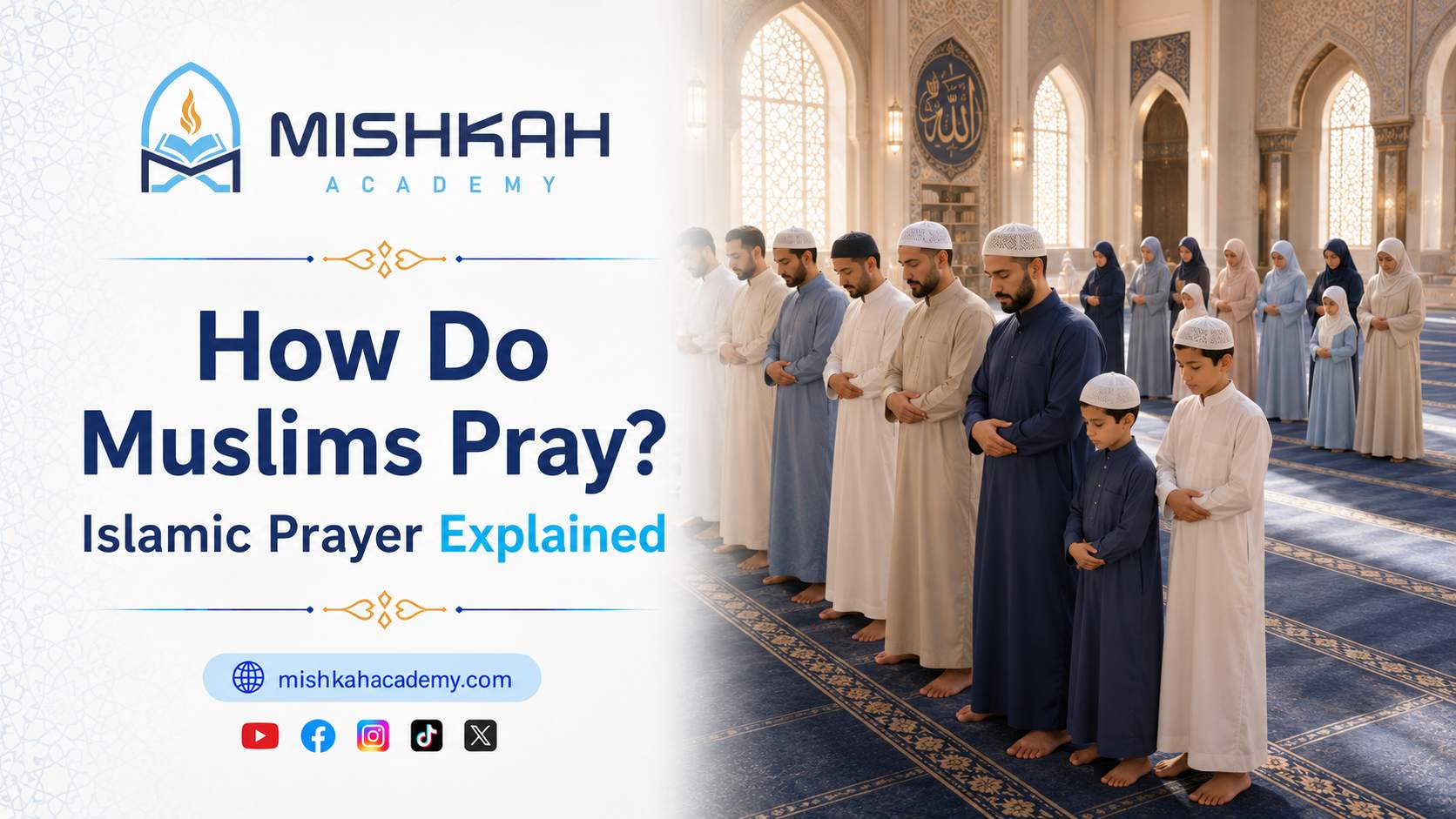
If you’ve ever watched a Muslim pray and wondered what it means, or you’re a new Muslim trying to understand the prayer beyond its movements, this guide explains the why behind Salah — its meaning, its times, and the role it plays in a Muslim’s daily life.
What Is Prayer in Islam?
Table of Contents
TogglePrayer in Islam is called Salah — a structured act of worship performed five times a day, at fixed times, involving specific words and physical positions: standing, bowing, and prostrating. It is not a casual or optional ritual; it is the second of the Five Pillars of Islam, the framework every practicing Muslim’s life is built around.
What Does Salah Mean?
The word Salah comes from an Arabic root meaning “connection” or “communication.” Through Salah, a Muslim speaks directly to Allah — no intermediary, no appointment, five times a day. The Prophet ﷺ described its place in faith simply:
الصَّلَاةُ عِمَادُ الدِّينِ
As-salaatu imaadud-deen — “Prayer is the pillar of the religion.” (Al-Bayhaqi)
Why Do Muslims Pray?
Muslims pray to worship Allah, express gratitude, and stay mindful of His presence throughout the day. The Quran describes prayer as something that shapes character, not just a physical routine: “Indeed, prayer prohibits immorality and wrongdoing” (Surah Al-Ankabut 29:45). Salah is also an act of accountability — the Prophet ﷺ taught that prayer is the first matter a person will be asked about on the Day of Judgment.
Why Do Muslims Pray Five Times a Day?
The five daily prayers were made obligatory during the Prophet’s ﷺ Night Journey (Al-Isra wal-Mi’raj). Rather than a burden, they function as five spiritual checkpoints spread across the day — before dawn, midday, afternoon, sunset, and night — keeping a Muslim connected to Allah through work, rest, and everything in between.
The Five Daily Prayer Times
| Prayer | Arabic | Time Window |
|---|---|---|
| Fajr | الفَجْر | Dawn until just before sunrise |
| Dhuhr | الظُّهْر | After midday until mid-afternoon |
| Asr | العَصْر | Mid-afternoon until just before sunset |
| Maghrib | المَغْرِب | Just after sunset until twilight ends |
| Isha | العِشَاء | After twilight until before Fajr |
Because these times follow the sun rather than the clock, they shift slightly day to day — most Muslims use a prayer times app or a local mosque schedule to stay accurate.
Obligatory, Sunnah and Voluntary Prayers
Not every unit of prayer carries the same ruling:
- Fard (obligatory) — the core rak’ahs of each of the five prayers; these are non-negotiable.
- Sunnah — additional rak’ahs the Prophet ﷺ regularly prayed before or after the fard prayers, recommended but not obligatory.
- Nawafil (voluntary) — extra prayers like Duha or Tahajjud, prayed for additional reward outside the five daily prayers.
A beginner should focus on mastering the fard prayers first, then gradually add sunnah prayers as they grow more comfortable.
Individual and Congregational Prayer
Salah can be prayed alone anywhere clean — the Prophet ﷺ said, “The whole earth has been made a masjid for me” (Bukhari). But praying in congregation (jama’ah) at a mosque, especially for men, carries far greater reward — traditionally described as 27 times that of praying alone — and reflects the communal nature of Islamic worship.
What Happens During Muslim Prayer?
Each rak’ah follows the same rhythm: standing with recitation, bowing in ruku, and prostrating twice in sujood, with set words at every position. The number of rak’ahs differs by prayer, from two (Fajr) to four (Dhuhr, Asr, Isha).
For the complete movements, recitations, and rak’ah-by-rak’ah instructions, follow our step-by-step guide to praying Salah.
The Spiritual Meaning of Salah Movements
Each posture in Salah carries meaning beyond the physical:
- Standing (Qiyam) reflects presenting oneself before Allah with full attention.
- Bowing (Ruku) is an expression of humility and respect.
- Prostration (Sujood) — placing the forehead on the ground — is the posture of complete submission, and the Prophet ﷺ described it as the moment a servant is closest to their Lord.
- Sitting (Tashahhud) closes the prayer with testimony of faith and peace upon the Prophet ﷺ and all righteous believers.
Differences Between Fajr, Dhuhr, Asr, Maghrib and Isha
Beyond timing, the five prayers differ in rak’ah count and recitation style. Fajr and the first two rak’ahs of Maghrib and Isha are prayed with audible recitation of Al-Fatihah and the following surah; Dhuhr and Asr, and the later rak’ahs of Maghrib and Isha, are recited silently. Fajr has 2 fard rak’ahs, Maghrib has 3, and Dhuhr, Asr, and Isha each have 4.
Can Muslims Pray Anywhere?
Yes. As long as the place is clean and free of impurity, Salah can be prayed at home, at work, outdoors, or while traveling — with allowances for shortening and combining prayers on a journey. A dedicated prayer mat is recommended but not required.
How Salah Shapes a Muslim’s Daily Life
Because the five prayer times are spread from before dawn to night, Salah naturally structures a Muslim’s entire day — a built-in rhythm of pause, reflection, and reconnection between work, family, and rest. Over time, this repetition builds discipline and keeps faith present in daily routine rather than confined to special occasions.
Muslim Prayer Explained in Video
[Video placeholder: Mishkah Academy original explainer — the meaning and purpose behind Muslim prayer.]
Frequently Asked Questions
- Is Salah the same as Dua?
No. Salah is the structured, obligatory prayer performed at fixed times with set words and movements. Dua is personal, free-form supplication that can be made anytime, in any language.
- What happens if a Muslim misses a prayer?
A missed prayer should be made up (qada) as soon as possible. Deliberately abandoning prayer without valid reason is considered a serious matter in Islam.
- Do women pray the same way as men?
The core structure is the same, with minor differences in hand positioning and covering (awrah) requirements. Women are exempted from Salah during menstruation and postnatal bleeding.
- Can new Muslims pray before memorizing everything?
Yes — a new Muslim can begin learning gradually, starting with Al-Fatihah and the essential phrases, while building up full fluency over time.
Ready to perform your first prayer? Follow our complete guide on how to pray Salah step by step.
New to Islam or want to understand the Arabic you recite in prayer? Explore Mishkah Academy’s courses for new Muslims and learn with a certified tutor, one on one.