
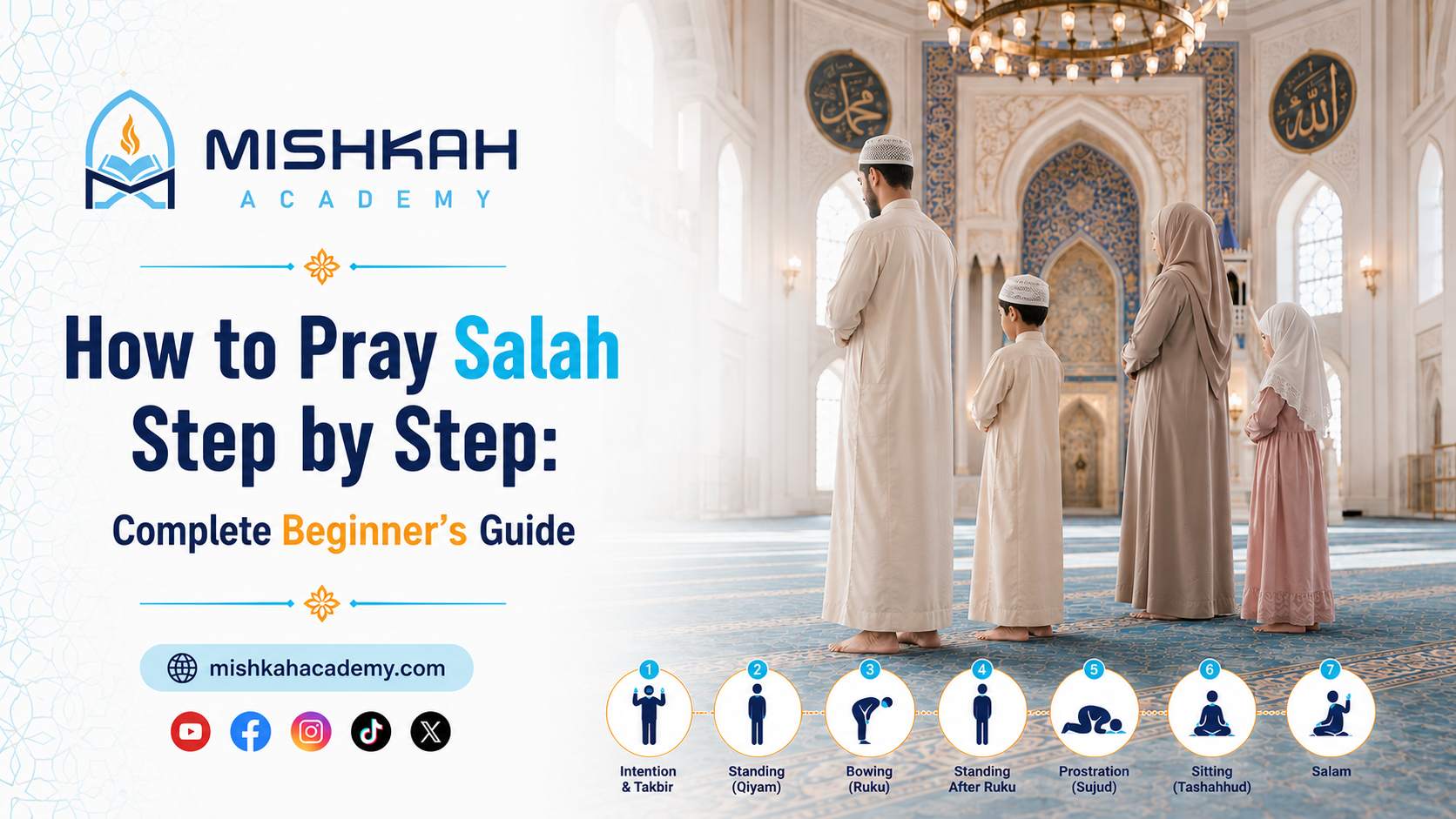
Salah is the second pillar of Islam, prayed five times a day. If you’re ready to learn exactly how to perform it — the movements, the words, and the order — this guide walks you through every step.
How to Perform Salah
Table of Contents
ToggleTo pray Salah, make wudu, face the Qiblah, and make the intention (niyyah) in your heart. Say “Allahu Akbar” to begin, recite Surah Al-Fatihah and another surah while standing, bow in ruku, rise, prostrate twice in sujood with a brief sitting between them, and repeat this cycle for the required number of rak’ahs. Sit for the Tashahhud after the second rak’ah and at the end, then finish by turning your head right and left saying the Salam.
What You Need Before Salah
Before you begin, four things must be in place:
- Wudu (ablution) — or ghusl if you’re in a state of major impurity
- A clean body, clothing, and place to pray
- The awrah covered — men from navel to knee; women everything except the face and hands
- Facing the Qiblah, the direction of the Kaabah in Makkah
1- Wudu and Purification
Wudu prepares you physically and spiritually for Salah. In short: say Bismillah, wash your hands, rinse your mouth and nose, wash your face, wash your arms to the elbows, wipe your head and ears, then wash your feet to the ankles — each step generally done three times (once for the head wipe).
2- Facing the Qiblah and Covering the Awrah
Use a compass or a qibla app to find the direction of the Kaabah if you’re unsure. Make sure your clothing is clean and modestly covers what is required before you start — checking this after you’ve already begun interrupts your prayer.
3- Making the Intention
Niyyah is made in the heart, not spoken aloud. Before you say the opening Takbir, simply know which prayer you are about to perform — for example, “I am praying two rak’ahs of Fajr.”
How to Pray Salah Step by Step
Every rak’ah (unit of prayer) follows the same core sequence. Learn this once, and you’ve learned the foundation of all five daily prayers.
- Takbir — Stand facing the Qiblah, raise your hands to ear level, and say “Allahu Akbar” (“Allah is the Greatest”). Place your right hand over your left on your chest.
- Recitation — Recite Surah Al-Fatihah, then a second surah or a few verses (required only in the first two rak’ahs of a prayer).
- Ruku (bowing) — Say “Allahu Akbar,” bow until your back is flat and parallel to the ground, hands on your knees, and recite “Subhana Rabbiyal Azeem” three times.
- Rising from Ruku — Stand up saying “Sami’ Allahu liman hamidah,” then “Rabbana wa lakal hamd.”
- Sujood (prostration) — Say “Allahu Akbar” and prostrate on seven points: forehead and nose, both palms, both knees, and the toes of both feet. Recite “Subhana Rabbiyal A’la” three times.
- Sitting between the two prostrations (Jalsah) — Sit briefly on your left foot and recite “Rabbighfir li” (“My Lord, forgive me”).
- Second Sujood — Prostrate again, repeating the same recitation as step 5.
That completes one rak’ah.
How to Complete Two, Three, and Four Rak’ahs
After the second rak’ah of any prayer, sit for the Tashahhud instead of standing immediately. If the prayer has only two rak’ahs (like Fajr), remain seated, recite the Tashahhud plus the Salawat on the Prophet ﷺ, and finish with the Salam.
If the prayer has three or four rak’ahs (Maghrib, Dhuhr, Asr, Isha), recite only the shorter Tashahhud after the second rak’ah, then stand and continue — reciting Al-Fatihah alone (no additional surah) in the remaining rak’ahs. After the final rak’ah, sit again for the complete Tashahhud, add the Salawat, and end with the Salam.
What to Say During Salah
| Position | What to Recite | Meaning |
|---|---|---|
| Opening (after Takbir) | Subhanaka Allahumma wa bihamdika… | Glory be to You, O Allah, and praise be to You |
| Standing (Qiyam) | Surah Al-Fatihah | The opening chapter — recited in every rak’ah |
| After Al-Fatihah | A short surah (e.g. Al-Ikhlas) | Only in the first two rak’ahs |
| Ruku | Subhana Rabbiyal Azeem (x3) | Glory be to my Lord, the Great |
| Rising from Ruku | Sami’ Allahu liman hamidah / Rabbana wa lakal hamd | Allah hears whoever praises Him / Our Lord, all praise is Yours |
| Sujood | Subhana Rabbiyal A’la (x3) | Glory be to my Lord, the Most High |
| Between the two Sujoods | Rabbighfir li | My Lord, forgive me |
| Tashahhud | At-tahiyyatu lillahi… | All greetings and prayers belong to Allah |
| Salam | Assalamu Alaikum wa Rahmatullah | Peace and Allah’s mercy be upon you |
Number of Rak’ahs in the Five Prayers
| Prayer | Fard (obligatory) | Sunnah before | Sunnah after |
|---|---|---|---|
| Fajr | 2 | 2 | — |
| Dhuhr | 4 | 4 | 2 |
| Asr | 4 | 4 (optional) | — |
| Maghrib | 3 | — | 2 |
| Isha | 4 | — | 2 (+ Witr) |
Common Salah Mistakes
- Rushing through ruku and sujood instead of pausing calmly
- Skipping or rushing wudu
- Forgetting the Qiblah direction
- Not reciting Al-Fatihah correctly
- Losing focus or looking around instead of at the place of sujood
What Invalidates Salah?
Salah is broken by: losing wudu during the prayer, intentionally speaking words unrelated to the prayer, laughing out loud, eating or drinking, or deliberately turning away from the Qiblah. If you make a minor mistake, like forgetting a part, perform Sujood As-Sahw — two extra prostrations — before the final Salam.
Salah Step-by-Step Video
Frequently Asked Questions
Can I pray in English if I don’t know Arabic yet?
Surah Al-Fatihah and the core recitations must be in Arabic, since they are a pillar of the prayer. While learning, work toward memorizing Al-Fatihah as a priority.
What if I forget how many rak’ahs I’ve prayed?
Act on the lower number, complete the prayer accordingly, then perform Sujood As-Sahw before the Salam.
Do I have to pray in a mosque?
No — Salah can be performed anywhere clean, though congregational prayer carries greater reward.
How long does one prayer take?
A single fard prayer typically takes 3–8 minutes when performed calmly and correctly.
To understand what Salah means, why Muslims pray five times a day, and how it shapes daily life, read our guide to Muslim prayer explained.
Want personal guidance to perfect your Salah and recitation? Join a free trial class with Mishkah Academy and learn one-on-one with a certified tutor.