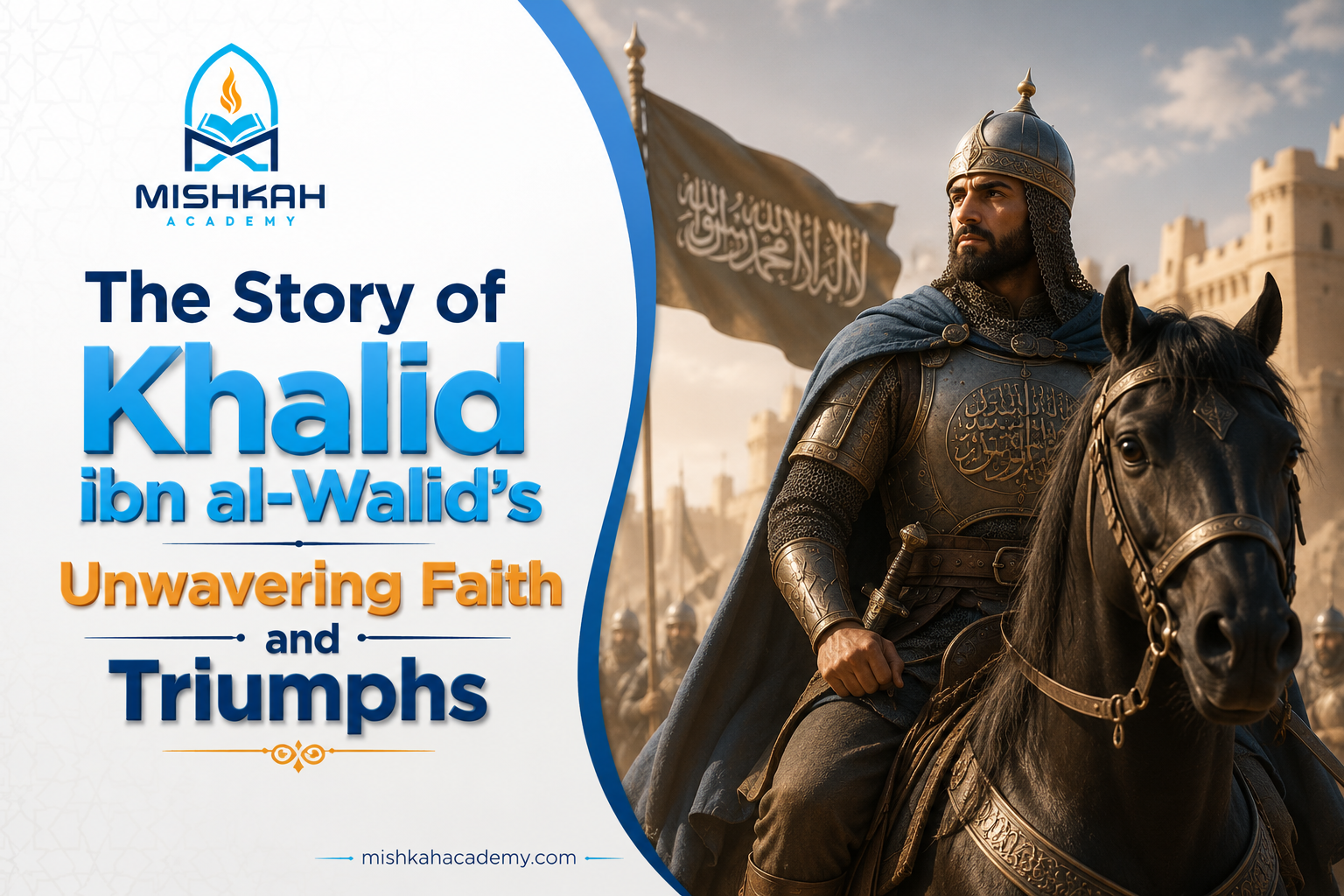
He fought in over 100 battles and never lost a single one. He commanded armies against the mightiest empires of his age — Byzantium and Persia — and left them broken. He was given a title by the Prophet Muhammad ﷺ himself, a title no other companion received: Saifullah — the Sword of Allah.
Yet when death came for Khalid ibn al-Walid, it did not come on a battlefield. It came quietly, in his bed — and he wept.
This is the story of one of the most extraordinary human beings who ever lived: a man who began as Islam’s most dangerous enemy and ended as its most formidable defender.
Early life — born for greatness
Table of Contents
ToggleKhalid ibn al-Walid was born around 585 CE in Mecca into the Banu Makhzum clan of the Quraysh — one of the most prestigious and militarily powerful tribes in Arabia. His father, Al-Walid ibn al-Mughirah, was one of the wealthiest and most influential men in Mecca, known as a leader of stature and authority.
From boyhood, Khalid trained in horsemanship, archery, and swordsmanship. The Banu Makhzum were the tribe responsible for horses and cavalry in Meccan warfare — and Khalid proved to be their finest product. By the time he was a young man, his tactical instinct and physical courage were already the subject of admiration among the Arabs.
What made Khalid exceptional was not just his bravery but his mind. He read battlefields the way scholars read books — noticing terrain, anticipating movement, and finding the angle no one else saw. This gift would define his entire life.
Against Islam — the years of opposition
When the Prophet Muhammad ﷺ began preaching Islam, Khalid stood firmly among his opponents. He did not persecute Muslims personally, but he dedicated his military genius to the Quraysh’s campaign against the Muslim community.
The Battle of Uhud (625 CE) — his most consequential act as an opponent
At the Battle of Uhud, Khalid commanded the Quraysh cavalry on the left flank. The Muslim archers, positioned on a hill, had been instructed by the Prophet ﷺ never to leave their posts regardless of what happened below. When the Quraysh began to retreat and the Muslims moved to collect the spoils, most of the archers left their positions.
Khalid saw the opening instantly. He wheeled his cavalry around the hill, attacked the exposed Muslim rear, and turned a Muslim victory into a devastating reversal. Seventy companions were martyred, including the Prophet’s uncle Hamza (RA). It was Khalid’s tactical brilliance that inflicted the greatest loss the Muslim community had yet suffered — and it came from abandoning a direct command of the Prophet ﷺ.
This moment shows both what Khalid was capable of and, in retrospect, how much was at stake when such a mind eventually joined the side of Islam.
The conversion — a letter, a dream, and a choice
The turning point came gradually. Khalid had watched Islam grow despite every effort to stop it. He had seen the steadfastness of Muslims under persecution. He had witnessed the signing of the Treaty of Hudaybiyyah in 628 CE — and something in him began to shift.
His brother Walid ibn al-Walid, who had already embraced Islam, wrote him a letter urging him to come to the Prophet ﷺ. He wrote: “I am astonished at a man of your intelligence — how can Islam be hidden from you? Where is your mind going?”
Around the same time, Khalid experienced a dream that he could not shake. He sought its interpretation and was told it pointed toward guidance and light ahead of him.
In Safar 8 AH (around 629 CE), Khalid ibn al-Walid rode to Madinah. On the road, he encountered Amr ibn al-‘As and Uthman ibn Talhah, also travelling to embrace Islam. The three arrived together. Khalid approached the Prophet ﷺ, gave the oath of allegiance, and said:
“O Messenger of Allah, I give you my allegiance — on condition that my past sins are forgiven.”
The Prophet ﷺ replied: “Islam wipes away what came before it.”
— Ibn Hisham, Sirah
Khalid ibn al-Walid was a Muslim. The most dangerous sword against Islam had just been placed in its hands.
Saifullah — how Khalid earned the title “Sword of Allah”
Less than two months after his conversion, Khalid was commanding Muslim forces in one of the most desperate moments in early Islamic history.
The Battle of Mutah (629 CE)
The Muslim army of 3,000 — sent to the Byzantine frontier — faced a Roman-allied force estimated at 100,000 to 200,000. The Muslim commanders fell one after another: Zayd ibn Harithah (RA), then Ja’far ibn Abi Talib (RA), then Abdullah ibn Rawahah (RA) — all three were killed.
The army was on the verge of collapse. Thabit ibn Arqam (RA) picked up the flag and called out: “O Muslims — agree on a leader!” They turned to Khalid. He had been Muslim for weeks.
What happened next is military legend. Khalid reorganised the shattered forces, launched a ferocious counterattack that confused the Byzantine commanders, and executed a tactical withdrawal so skillfully that the enemy believed it was a trap. The Muslims escaped with minimal further losses from an engagement that should have ended in annihilation.
When news reached the Prophet ﷺ in Madinah, he named Khalid before the people arrived — he already knew through revelation. And it was then that he gave him the title that would define him for all of history:
“Khalid is a sword from the swords of Allah, which He has unsheathed against the disbelievers.”
— Sahih Bukhari, reported through multiple chains
Saifullah. No other companion of the Prophet ﷺ received this title.
Major battles — an undefeated record
| Battle | Year (CE) | Against | Outcome |
|---|---|---|---|
| Battle of Mutah | 629 | Byzantine Empire | Tactical withdrawal — army saved |
| Conquest of Mecca | 630 | Quraysh (unopposed) | Victory |
| Battle of Hunayn | 630 | Hawazin & Thaqif tribes | Victory |
| Battle of Walaja | 633 | Persian Empire | Victory — double envelopment tactic |
| Battle of Ullais | 633 | Persian & Arab forces | Decisive victory |
| Siege of Al-Hira | 633 | Persian client state | Victory — first major Persian city taken |
| Battle of Yarmouk | 636 | Byzantine Empire | Decisive victory — Byzantines expelled from Syria |
Historians count over 100 engagements in Khalid’s career. He never lost one. Military historians from both Eastern and Western traditions have studied his campaigns — particularly his use of double envelopment (surrounding the enemy from both flanks) and his speed of movement — as models of strategic genius.
The Battle of Yarmouk (636 CE) — his masterpiece
The Battle of Yarmouk stands as one of the most decisive military encounters in human history. A Muslim army of approximately 25,000–40,000 faced a Byzantine force conservatively estimated at 80,000–100,000 — defending their empire’s claim to the Levant.
Khalid divided his army into 36–40 mobile units, using terrain, timing, and constant redeployment to neutralise the Byzantine numerical advantage. Over six days of fighting, he broke the Byzantine army decisively. The Roman Empire never again controlled Syria, Palestine, or Egypt in any meaningful way. The entire character of the Middle East was permanently altered in those six days.
The dismissal — and what it revealed about his character
In 638 CE, Caliph Umar ibn al-Khattab (RA) dismissed Khalid from military command. The reasons scholars cite include concerns that people were beginning to attribute Muslim victories to Khalid’s genius rather than to Allah’s help — a theological problem when dealing with a figure of such towering fame.
Khalid’s response to this dismissal is one of the most remarkable moments of his life. He had no tantrum, no bitterness, no political maneuvering. He simply said:
“I fight for Allah — not for Umar.”
He continued to serve as a soldier under the commanders who replaced him, fighting in the ranks with the same dedication he had shown as a general. This moment reveals something critical about Khalid’s faith: his military career was not about glory. It was about a conviction that had completely reoriented his life.
His death — the tears of a warrior
Khalid ibn al-Walid died in 642 CE in Homs, Syria, from illness — in his bed, surrounded by family. He had survived over 100 battles without ever being defeated. He had fought with such ferocity that at the Battle of Mutah alone, nine swords broke in his hand in a single day.
And yet, when the moment of death came, he wept. His companions asked him why. He replied:
“I have fought in so many battles seeking martyrdom, and yet here I am, dying in my bed like a camel dies. Let not the eyes of cowards find rest.”
— Ibn Kathir, Al-Bidaya wal-Nihaya
He died longing for the one thing his entire military career could not give him — the martyr’s death he had sought on every battlefield. He was buried in what is today the Khalid ibn al-Walid Mosque in Homs, Syria.
Umar ibn al-Khattab (RA), upon hearing of his death, said: “Women will never give birth to anyone like Khalid ibn al-Walid.”
Lessons from the life of Khalid ibn al-Walid
- Conversion transforms everything. The same mind and courage that once threatened Islam became its greatest military asset. The capacity was always there — what changed was its direction.
- Sincerity outlasts success. When dismissed from command, Khalid didn’t fight it. He served. That response — quiet, dignified, and faithful — tells us more about his character than any of his victories.
- The greatest honour is not fame but nearness to Allah. Khalid had every worldly honour — titles, victories, the Prophet’s personal praise. Yet he wept at death because he hadn’t received the one honour that mattered to him most: martyrdom in Allah’s cause.
- Genius is a trust. Khalid’s military brilliance was extraordinary. He understood that it was a gift to be used in service of something greater than himself — and he spent it accordingly.
Learn Islamic history the way it deserves to be learned
The story of Khalid ibn al-Walid is part of a vast, rich, and deeply inspiring history that most English-speaking Muslims encounter only in fragments. Understanding the Seerah (life of the Prophet ﷺ) and the lives of his companions in full — with their context, their human complexity, and their spiritual depth — requires dedicated study.
Mishkah Academy’s Islamic Studies Classes cover Islamic history, Seerah, Aqeedah, Fiqh, and more — taught by certified scholars from Al-Azhar University. For younger students, our Islamic Classes for Kids bring these stories to life in an age-appropriate, engaging way. And our Quranic Arabic Course allows students to read primary Islamic sources — including the words of the Prophet ﷺ about Khalid — directly in Arabic.
Frequently asked questions
Why is Khalid ibn al-Walid called the Sword of Allah?
The title Saifullah (Sword of Allah) was given to him directly by the Prophet Muhammad ﷺ after the Battle of Mutah in 629 CE. Facing a vastly superior Byzantine-allied force, Khalid took command after three successive commanders were martyred and managed to extract the Muslim army without total defeat. The Prophet ﷺ declared: “Khalid is a sword from the swords of Allah, which He has unsheathed against the disbelievers.”
Did Khalid ibn al-Walid ever lose a battle?
No. Military historians who have studied his campaigns — over 100 engagements across Arabia, Iraq, and Syria — have found no recorded defeat. He is considered one of the few undefeated generals in world military history, alongside figures such as Alexander the Great and Scipio Africanus.
When did Khalid ibn al-Walid convert to Islam?
He converted in Safar 8 AH, approximately 629 CE — just over a year before the conquest of Mecca. His conversion came after years of watching Islam grow, a letter from his brother, personal dreams, and ultimately a sincere conviction that the Prophet ﷺ was telling the truth.
Why did Umar dismiss Khalid from command?
Caliph Umar (RA) dismissed Khalid in 638 CE primarily out of concern that Muslims were attributing victories to Khalid personally rather than to Allah. When a general becomes so famous that people credit him rather than Allah for success, Islamic leadership considers this spiritually dangerous. Khalid accepted the dismissal without complaint and continued serving as a regular soldier.
How did Khalid ibn al-Walid die?
He died of illness in 642 CE in Homs, Syria — in his bed. Despite fighting in over 100 battles and surviving countless injuries, he never received the martyr’s death he longed for. He died weeping over this, and was buried in what is now the Khalid ibn al-Walid Mosque in Homs.
What is the best way to teach children about Khalid ibn al-Walid?
Children respond powerfully to hero stories — and Khalid’s is one of the most compelling in Islamic history. Mishkah Academy’s Islamic Classes for Kids introduce companions of the Prophet ﷺ through structured, age-appropriate lessons that make Islamic history vivid and personally meaningful.
Conclusion
Khalid ibn al-Walid’s life is a story of transformation so total that it seems almost impossible — until you remember that it is the power of sincere faith, directed by a clear mind and an extraordinary will. He went from Islam’s most dangerous adversary to its greatest military protector in the space of a single conversion.
He never lost a battle. He died weeping in his bed. And fourteen centuries later, his name is still spoken with reverence by over a billion Muslims around the world.
That is the mark of a life truly lived in the way of Allah. Explore more stories like his through Mishkah Academy’s Islamic Studies Classes — and book your free trial today.