Arabic is not just another language — it is the language of the Quran, the language of prayer, and the language the Prophet Muhammad (peace be upon him) spoke. For Muslims living in the West, whether in the United States, Canada, the United Kingdom, or Australia, understanding Arabic is one of the most transformative steps they can take in their spiritual and intellectual journey.
Yet many English-speaking Muslims grow up without Arabic, relying on translations that, by their very nature, fall short of the original. If you have ever wondered whether learning Arabic is worth the effort, this guide walks you through the most profound and practical benefits of learning Arabic for Muslims, and shows you exactly how to start.

10 Benefits of Learning Arabic for Muslims Worldwide
1. Connect Directly With the Words of Allah
The Quran was revealed in clear Arabic:
إِنَّآ أَنزَلْنَـٰهُ قُرْءَٰنًا عَرَبِيًّا لَّعَلَّكُمْ تَعْقِلُونَ
“Indeed, We have sent it down as an Arabic Quran that you might understand.”
— Quran 12:2 (Surah Yusuf)
Allah chose Arabic deliberately, and every word carries layers of meaning that no translation can fully capture. When you learn Arabic, you stop reading about the Quran and start reading the Quran. You notice the rhythm of divine speech, the precision of every verb tense, and the emotional weight of words that translators can only approximate. This is perhaps the single greatest benefit of learning Arabic for Muslims, and it alone makes the journey worthwhile.
Our Quranic Arabic Course is designed specifically to help English-speaking Muslims unlock this connection, no prior Arabic knowledge required.
2. Understand Your Daily Prayers (Salah)
Every Muslim prays five times a day, yet many rely on memorized recitation without understanding every phrase. Al-Fatiha alone contains seven ayat of profound theological depth. Understanding Arabic can deepen awareness, reflection, and khushu‘ in Salah.
“Learn Arabic.”
— Umar ibn al-Khattab (radiy Allahu ‘anhu), narrated in al-Bayhaqi’s Sunan al-Kubra
This is a saying of the Companion Umar ibn al-Khattab, not a hadith of the Prophet. The bare exhortation “learn Arabic” has a sound chain back to Umar. A longer version sometimes circulated online, adding “for it is part of your religion” or “for it strengthens the mind,” is not soundly established, and Islamic scholars researching this specific narration have found its extended wording carries weak chains. What is reliably established is simply this: a companion as close to the Prophet as Umar considered learning Arabic worth actively encouraging.
A great starting point is our Arabic Course for Beginners, which covers Salah vocabulary, essential supplications (dua), and Quranic phrases in an approachable, step-by-step curriculum.
3. Deepen Your Understanding of Tajweed and Quran Recitation
Tajweed, the science of correct Quran recitation, is built entirely on Arabic phonetics. Rules like Idgham, Ikhfa, Madd, and Qalqalah are deeply connected to how Arabic letters behave. A student who understands Arabic grasps Tajweed rules far more naturally than one who memorizes them in isolation.
Mishkah Academy offers dedicated Online Tajweed Classes for all levels, from beginners learning their first rules to advanced students pursuing an Ijazah certification.
4. Access Islamic Scholarship in Its Original Form
The vast library of Islamic knowledge, tafseer, fiqh, hadith, seerah, and aqeedah, exists primarily in Arabic. Scholars like Ibn Katheer, Imam al-Nawawi, and Ibn Taymiyyah wrote in Arabic. When you read their works in translation, you are relying on someone else’s interpretation of their interpretation. Learning Arabic removes that middleman.
This benefit extends to contemporary Islamic learning too. Our Tafseer Quran Course and Islamic Studies Classes both become significantly richer once students have a working knowledge of Arabic.
5. Support Your Children’s Islamic Education
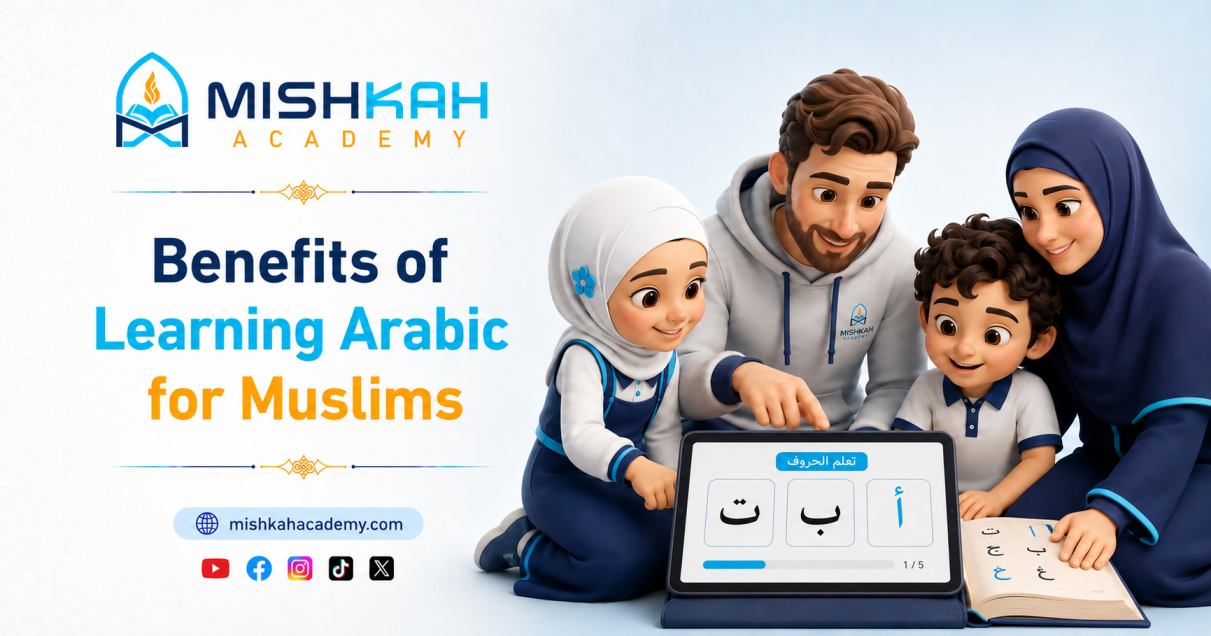
Muslim parents in the West face a constant challenge: raising children who are proud of their faith and connected to its sources in an overwhelmingly secular environment. A parent who knows Arabic can help with Quran homework, explain the meaning of surahs, and make Islamic learning a shared family experience.
Mishkah Academy offers Arabic Classes for Kids and Quran Classes for Kids, so the whole family can learn together, each at their own level.
6. Strengthen the Bond With 400 Million Arabic Speakers Worldwide
Arabic is spoken by roughly 400 million people across 22 countries and is one of the six official languages of the United Nations. For Muslims, this goes beyond linguistics, it is a bridge to the Ummah. When you travel for Hajj or Umrah, meet Arab Muslims in your community, or watch Islamic lectures from scholars in Egypt, Saudi Arabia, or Morocco, Arabic makes you a full participant rather than an observer.
Our Arabic Conversation Course is specifically designed for students who want to move beyond reading and start speaking confidently with native Arab Muslims.
7. Boost Career Opportunities in a Globalized World
Arabic is increasingly valuable in international business, diplomacy, journalism, law, healthcare, and intelligence sectors. For Muslim professionals in the US, UK, Canada, and Australia, Arabic fluency can open doors to roles in the Middle East, North Africa, and within international organizations. Arabic has long been classified by the U.S. government among its strategically critical languages for diplomatic and government careers, reflecting sustained demand for Arabic fluency in these fields.
8. Strengthen Language Awareness, Memory Practice, and Focus
Learning Arabic gives students regular practice in vocabulary recall, close listening, pronunciation, and pattern recognition. Its root-and-pattern system can also help learners see relationships between words and build stronger language awareness. These are practical learning benefits; current research does not justify claiming that Arabic produces a unique neurological advantage simply because it is written from right to left.
Research on bilingualism has explored possible relationships with attention and executive control, but findings vary by population, study design, and language experience. The strongest reason to learn Arabic here is not a promised brain boost; it is the sustained mental discipline of learning and using a rich additional language.
9. Make Quran Memorization (Hifz) More Effective
Memorizing the Quran is a noble goal for millions of Muslims. But memorization without understanding is harder to retain. When you understand the meaning of what you are memorizing, the vocabulary, the grammar, the flow of meaning, your brain stores it more deeply and recalls it more reliably.
This is why Mishkah Academy integrates Arabic vocabulary into its Online Hifz Course and its Quran Memorization Program, so students memorize with comprehension, not just repetition.
10. Experience the Spiritual Rewards of Learning Arabic
Islamic tradition holds that seeking knowledge is a form of ibadah (worship). The Prophet (peace be upon him) said:
“Whoever follows a path seeking knowledge, Allah will make easy for him the path to Paradise.”
— Sahih Muslim, 2699a
Learning Arabic, the language of the Quran, is one of the most direct forms of this sacred pursuit.
There is also the matter of dua. When you make supplication in Arabic, the language of the Quran, many scholars note a qualitatively different feeling of closeness to Allah. Language shapes thought, and thinking in Arabic while worshipping shapes the heart in ways that translation cannot fully replicate.

How to Start Learning Arabic as an English-Speaking Muslim
The good news is that you do not need to move to an Arabic-speaking country or spend years in a classroom. Mishkah Academy offers flexible online Arabic courses taught by native Arab tutors, certified scholars from Al-Azhar University, available from the comfort of your home, on your schedule.
Here is the recommended learning path:
- Complete Beginners: Start with the Noorani Qaida Course to master Arabic letters and pronunciation.
- Intermediate Learners: Enrol in the Quranic Arabic Course to understand the language of the Quran directly.
- Advanced Students: Explore the Classical Arabic Course or Modern Standard Arabic Course to unlock the full breadth of the language.
- For Sisters: Our Arabic Classes for Sisters provide a comfortable, female-only learning environment.
- For Children: Enrol them in Arabic Classes for Kids with tutors trained in engaging young learners.
Ready to Begin?
Book your free trial class at Mishkah Academy today, and experience the difference that Arabic makes in your faith from your very first lesson.
Book a Free Trial Class ·
Why Arabic Matters for Muslims Abroad
Frequently Asked Questions
Is it obligatory for Muslims to learn Arabic?
Every Muslim must learn the recitations and phrases necessary to perform Salah correctly, including Al-Fatiha. This does not mean that becoming fluent in Arabic is individually obligatory for every Muslim. Broader study of Quranic Arabic is highly beneficial and strongly encouraged, while detailed legal formulations differ among scholars.
How long does it take to learn Arabic as a Muslim?
The timeline depends on the learner’s starting point, study frequency, goals, and opportunities to practise. Basic reading and recognition of common Quranic vocabulary may develop within several months of consistent study, while strong comprehension or conversational fluency usually requires sustained learning over a longer period. A structured course can help, but no responsible program should guarantee one fixed timeline for everyone.
Can adults learn Arabic from scratch?
Yes. Adults can use existing study habits, grammar awareness, and life experience to learn effectively from the beginning. Progress varies, but consistent practice and clear goals matter more than age alone.
What is the difference between Quranic Arabic and Modern Standard Arabic?
Quranic Arabic (Classical Arabic) is the language of the Quran and classical Islamic texts, grammatically rich and poetically precise. Modern Standard Arabic (MSA) is used in contemporary media, literature, and formal settings. Both are taught at Mishkah Academy.
Do I need to know Tajweed before learning Arabic?
No, they can be learned simultaneously. Many students study Tajweed rules alongside Arabic vocabulary. In fact, understanding Arabic makes Tajweed rules easier to apply in context.
Conclusion
The benefits of learning Arabic for Muslims extend far beyond the ability to communicate in a foreign language. Arabic is the key to the Quran, to Salah, to Islamic scholarship, and to a deeper, more personal relationship with Allah. For English-speaking Muslims in the West, learning Arabic is one of the most meaningful investments you can make in your faith, and it is far more accessible today than it has ever been.
Mishkah Academy brings certified native Arab tutors from Al-Azhar University directly to your screen, with flexible scheduling, affordable pricing, and a curriculum designed for English-speaking Muslim families.
Explore all our Arabic courses and book your free trial class today. The path to the Quran begins with one word.
Sources: Quran 12:2; Sahih Muslim 2699a; al-Bayhaqi, Sunan al-Kubra (saying attributed to Umar ibn al-Khattab).